 Home
Home


For further details, please contact us.
Contact Us
What Sets Dry-Type and Oil-Immersed Capacitors Apart
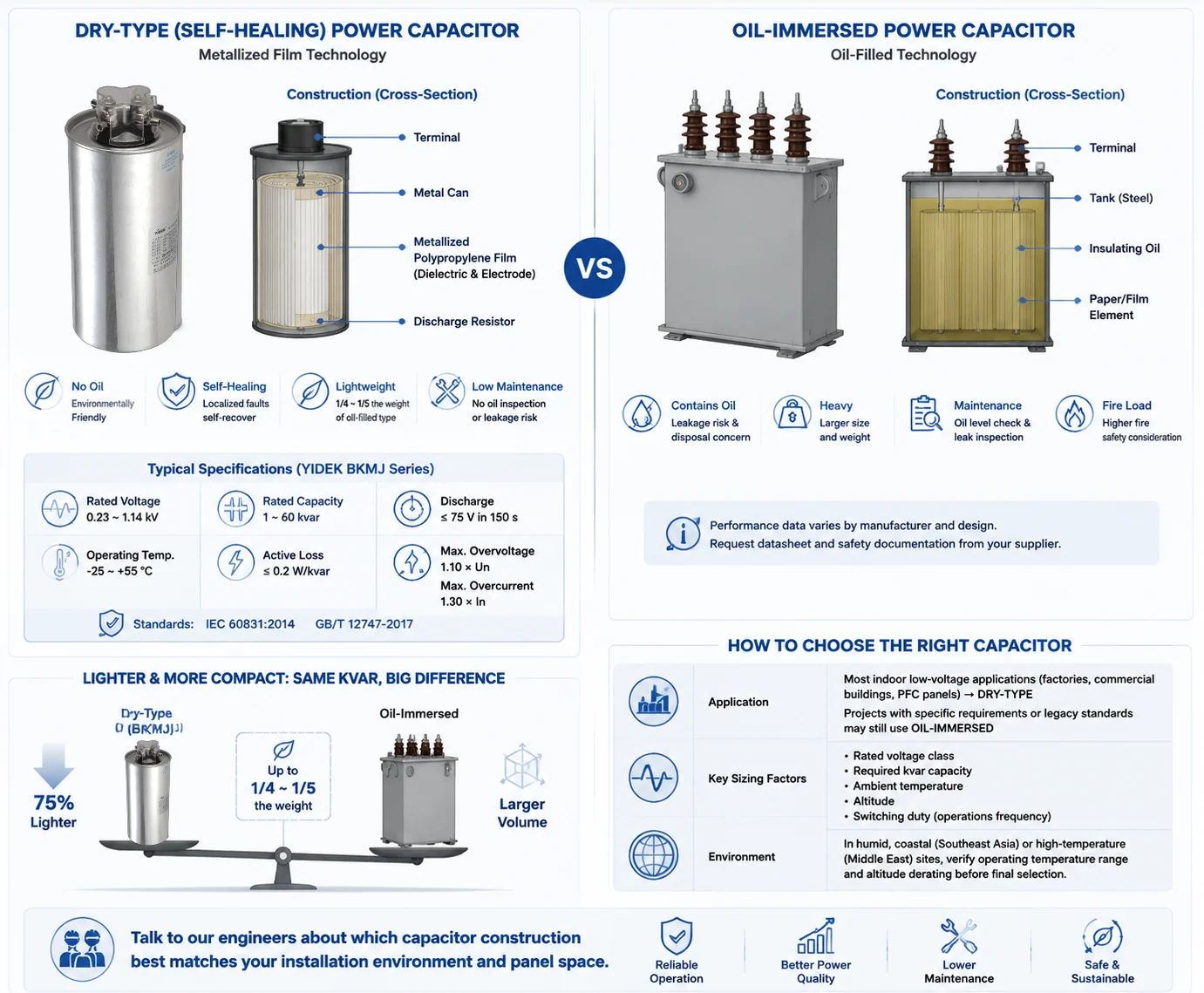
The core difference between the two capacitor types is the dielectric medium and cooling method used inside the case.
Dry-type capacitors use metallized polypropylene film as both the dielectric and the internal electrode, with no liquid insulating or cooling medium; the case simply houses the wound film elements.
Oil-immersed capacitors use paper or film elements submerged in an insulating oil that improves heat dissipation and dielectric strength, but adds weight, requires periodic oil-level and leak inspection, and raises questions around disposal and fire load at end of life.
Because dry-type units eliminate the liquid medium entirely, they tend to be lighter, more compact for the same rated capacity, and free of the oil-leak failure mode that older oil-filled designs are known for.
Dry-Type (Self-Healing) Capacitors: What the Data Shows
YIDEK's YD-R series illustrates what the dry-type, self-healing category looks like in practice: metallized-film construction rated from 0.23 to 1.14kV and 1 to 60kvar, weighing only about a quarter to a fifth of a traditional oil-filled capacitor at the same rating, with active loss kept at or below 0.2W/kvar.
The self-healing property means a localized dielectric breakdown clears itself automatically rather than propagating into a full failure, and a built-in discharge resistor brings residual voltage below 75V within 150 seconds of disconnection for safe handling.
The units are rated for a maximum allowable overvoltage of 1.10 times the rated voltage and 1.30 times the rated current, and are certified to IEC 60831:2014 and GB/T 12747-2017, with an operating range of -25°C to +55°C and no oil to leak.
For oil-immersed capacitors, the specific performance figures depend heavily on the manufacturer and construction, so buyers evaluating that option should request the datasheet and safety documentation directly from the supplier rather than relying on generic assumptions.
For detailed specifications of YIDEK's dry-type power capacitor, you can refer to our power capacitor and reactor product page.
Choosing Between the Two for Your Site
For most indoor low-voltage installations across manufacturing plants, commercial buildings, and PFC panels, dry-type self-healing capacitors are now the more common specification, largely because of the reduced weight, easier installation into standard panel footprints, and the absence of oil-related maintenance and disposal considerations.
Oil-immersed capacitors remain a valid choice mainly where a project specifically calls for that dielectric system, for example due to an existing standard on site or a preference carried over from legacy equipment already installed.
Whichever type is under consideration, the deciding factors that matter for sizing are the same: rated voltage class, required kvar capacity, ambient temperature and altitude at the installation site, and the switching duty the capacitor will see in service.
In humid coastal environments common across Southeast Asia, or in high-ambient-temperature sites in the Middle East, the working temperature range and altitude derating of the selected capacitor should also be checked against local site conditions before finalizing the choice.
To explore complete compensation systems that integrate these capacitors, visit our capacitor bank and PFC system page.
Talk to our engineers about which capacitor construction best matches your installation environment and panel space.