 Home
Home


For further details, please contact us.
Contact Us
How Smart Capacitor Modules Are Actually Mounted
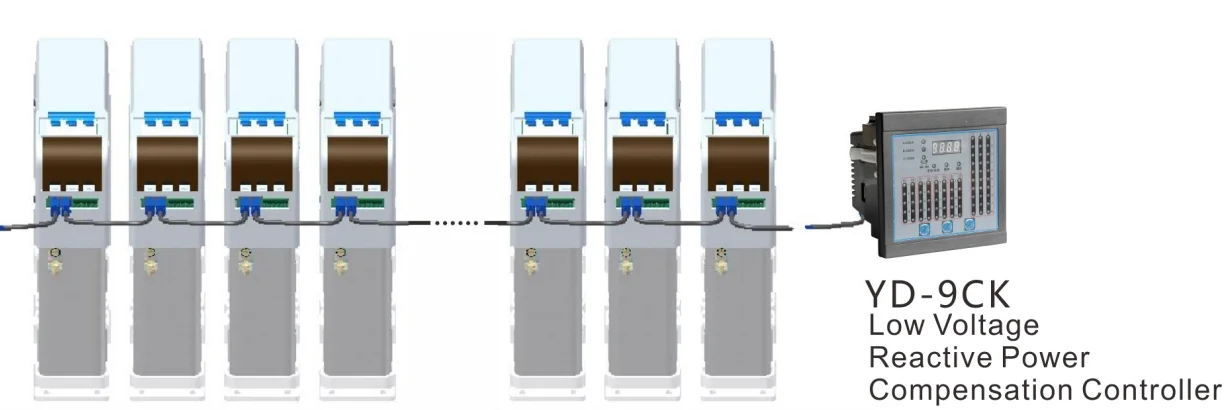
For most low-voltage smart capacitor modules, including YIDEK's YD-8C and YD-868R(S/F)E series, the practical choice is less "rack versus wall" and more about the mounting footprint and depth available inside your compensation panel: these modules are designed to bolt onto a baseplate or mounting rail inside a standard low-voltage switchgear cabinet via bottom mounting studs, rather than being offered as a separate free-standing, wall-hung enclosure.
The YD-8C series, for example, is specified with a fixed width and depth footprint and a height that scales with rated capacity, while the YD-868R(S/F)E series has an outline of 365mm (width) by 88mm (depth), with height varying by model.
In both cases, the module sits inside the panel and connects to the busbar and data line from the rear, so the relevant sizing question is panel depth and mounting-rail spacing rather than a rack-versus-wall enclosure decision. For detailed specifications of YIDEK's smart capacitor series, you can refer to our smart capacitor module product page.
Space and Footprint Considerations by Capacity
Because module height increases with rated capacity, panel space planning should be done capacity-first.
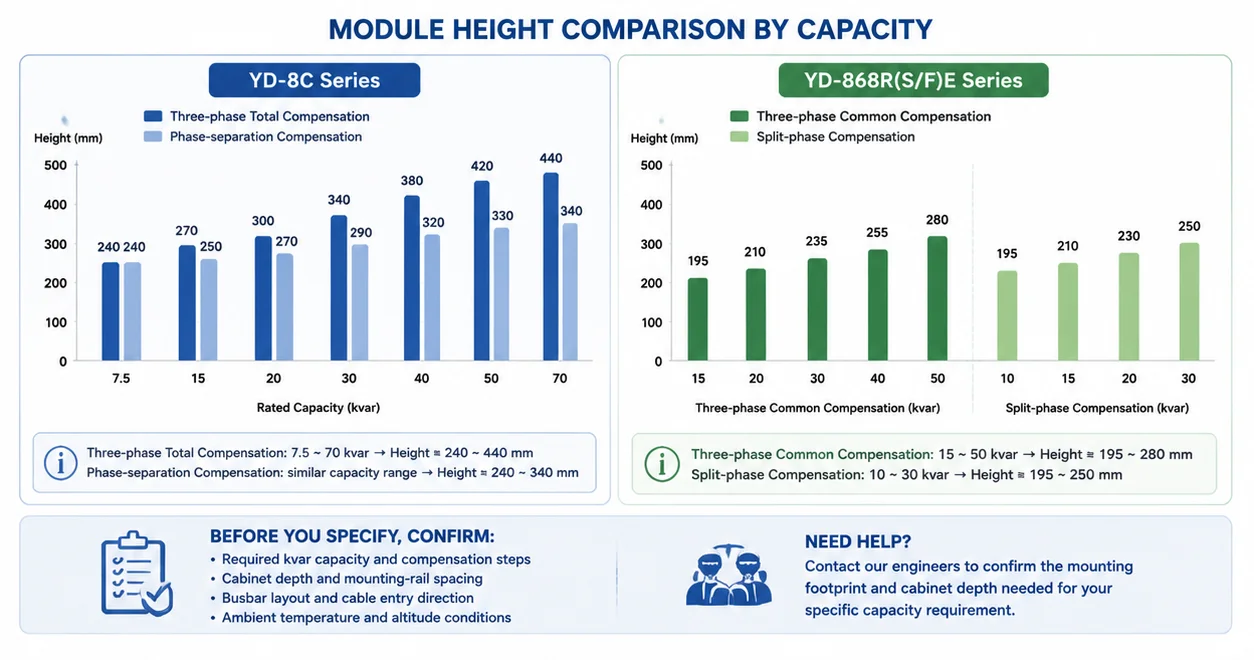
On the YD-8C series, three-phase total-compensation units range from roughly 240mm to 440mm in height across the 7.5 to 70kvar range documented for that series, while phase-separation-compensation units run from about 240mm to 340mm across a comparable capacity range.
On the YD-868R(S/F)E series, three-phase common-compensation modules run from 195mm to 280mm in height across the 15 to 50kvar range, and split-phase modules from 195mm to 250mm across the 10 to 30kvar range.
In practical terms, this means a panel designed for a small compensation step can accept a shorter module, while higher-capacity steps need to be budgeted for a taller unit within the same cabinet depth — a factor that matters more than whether the enclosure is described as "rack" or "wall" style, since both terms generally describe the same panel-mounted form factor for this product category.
What to Confirm Before You Specify
If your project genuinely requires a stand-alone, wall-hung enclosure rather than a panel-mounted module — for example, retrofitting a site with no existing switchgear cabinet — that is a different mechanical configuration from the standard smart capacitor module and should be confirmed directly with our engineering team rather than assumed from a generic "rack mounted smart capacitor module vs wall mounted smart capacitor module" comparison, since our current published manuals for the YD-8C and YD-868R(S/F)E series describe panel/cabinet mounting via bottom studs rather than distinct rack- and wall-mount product variants.
What can be confirmed from the documentation is the mounting footprint, height by capacity, and the bottom-stud mounting method, all of which your panel builder needs to lay out cabinet depth and busbar routing correctly before ordering.
To explore complete compensation systems that integrate these modules, visit our capacitor bank and PFC system page.
Contact our engineers to confirm the mounting footprint and cabinet depth needed for your specific capacity requirement.
Related Reading
-
What is a power capacitor, and how does it correct power factor?
-
What is a smart capacitor module, and how is it different from a traditional capacitor bank?
-
Power Factor Correction Solutions for Your Facility