 Home
Home


For further details, please contact us.
Contact Us
What APF Does vs What SVG Does
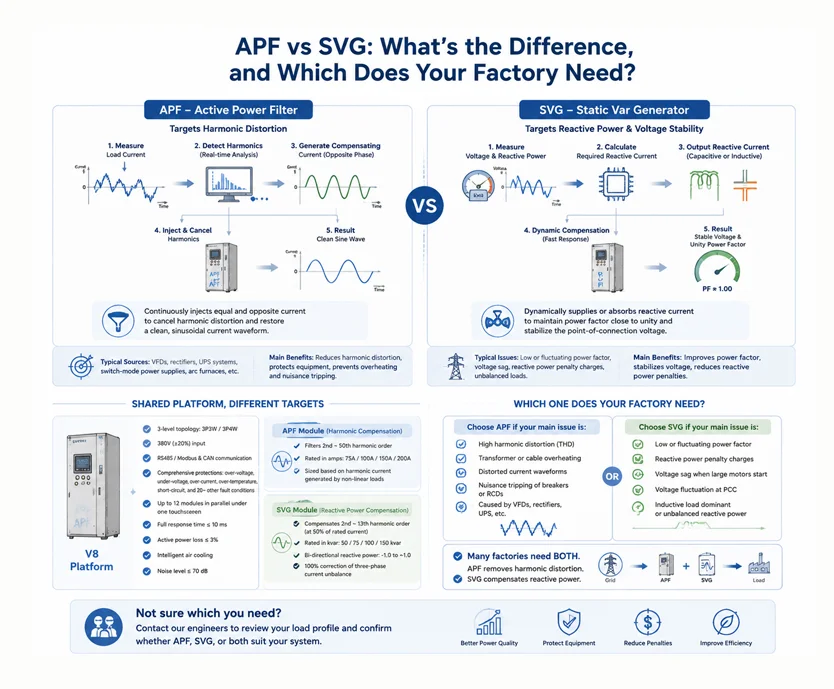
Active Power Filter (APF) and Static Var Generator (SVG) are both inverter-based compensation devices, but they are designed to correct different problems in your electrical system.
An APF continuously measures the harmonic content of the load current and injects an equal and opposite compensating current to cancel out harmonic distortion, addressing issues such as overheating transformers, nuisance tripping, and equipment malfunction caused by non-linear loads like variable-frequency drives, rectifiers, and UPS systems.
An SVG, by contrast, measures reactive power and voltage and dynamically supplies or absorbs reactive current to hold power factor close to unity and stabilize the point-of-connection voltage, which is the more relevant fix when your dominant issue is a fluctuating or lagging power factor rather than harmonic distortion.
On YIDEK's V8 platform, an APF module filters the 2nd through 50th harmonic order, while an SVG module addresses the 2nd through 13th order at 50% of rated current — reflecting that reactive power compensation, not deep harmonic cancellation, is the SVG’s core function.
Shared Platform, Different Compensation Targets
Both the YIDEK SVG & APF share the same physical module, a 3-level topology available in 3P3W and 3P4W configurations, 380V(±20%) input, RS485/Modbus and CAN communication, and a common set of protections covering over-voltage, under-voltage, over-temperature, over-current, short-circuit, and more than 20 other fault conditions. Up to 12 modules can be paralleled under a single touchscreen for larger installations, and both device types are rated for a full response time of 10 milliseconds or less, active power loss of 3% or below, and intelligent air cooling with a noise level of 70dB or below.
Where they diverge is the compensation range and rating structure: an SVG module is rated in kvar (available as 50, 75, 100, or 150kvar modules) with -1.0 to +1.0 bi-directional reactive power adjustment and 100% correction of three-phase current unbalance, while an APF module is rated in amps (available as 75, 100, 150, or 200A modules) sized to the harmonic current your non-linear loads are generating rather than to a kvar target. For a deeper look at the individual product specifications, you can explore our SVG and APF product page.
Which One Does Your Factory Need
If your facility's main symptom is a low or fluctuating power factor, penalty charges on the utility bill for reactive energy, or voltage sag at the point of common coupling when large motors start, an SVG is the more direct fix.
If instead you are seeing transformer overheating, distorted current waveforms, or protective-device nuisance tripping traced back to VFDs, rectifiers, or other non-linear equipment, an APF targets the harmonic content directly.
Many facilities with both symptoms end up specifying both device types on the same busbar, since the two functions are complementary rather than interchangeable — an SVG will not clean up harmonic distortion, and an APF will not by itself correct a lagging power factor from purely inductive loads.
Confirming which symptom is dominant, ideally with a power quality measurement at your site, is the most reliable way to decide between the two before finalizing a specification. To understand how these devices fit into broader compensation strategies, visit our power factor correction solution and harmonic mitigation solution pages.
Contact our engineers to review your load profile and confirm whether APF, SVG, or both suit your system.
Related Reading
-
What is a power capacitor, and how does it correct power factor?
-
What is a smart capacitor module, and how is it different from a traditional capacitor bank?
-
Dry-type vs oil-immersed power capacitors: how to choose for your application
-
Rack-Mounted vs Wall-Mounted Smart Capacitor Modules: Which Fits Your Installation Space?